Tuesday, July 31, 2012

England: Norfolk’s American Connections exhibition opens at the Archive Centre in Norwich

From EDP24:  Norfolk’s American Connections exhibition opens at the Archive Centre in Norwich

 While some of Norfolk’s North American links are well known and much-talked-about – like the still-remembered friendships with GIs during the second world war or Thetford writer Thomas Paine’s involvement in the American Revolution – others may come as more of a surprise.

So a look through the latest exhibition at The Archive Centre’s Long Gallery in Norwich is likely to throw up a few cries of “I didn’t know that!” or “were they really from Norfolk?”
From the Great Yarmouth sisters hanged during the Salem witchcraft trials to the Pilgrim fathers who hailed from Redenhall, near Diss, those connections stretch back hundreds of years.
Yesterday’s exhibition launch marked the start of a host of activities, lectures and performances which aim to enlighten both locals and visitors to Norfolk to the key people and events which have played such an important part in the history of this county and that of North America.
Derrick Murphy, Norfolk County Council leader and chairman of the Norfolk records committee, said: “I am really proud of this exhibition and the whole project.
“Officers at the council and our partners have put a lot of thought and hard work into Norfolk’s American Connections, and I hope it will bring a lot of pleasure to people in Norfolk and visitors to our county who are keen to find out more about its past.
“There are some truly fascinating links between us and North America, some of which are fairly well known, many of which are not.
“Because of the local relevance of the project and North America’s strategic importance in global affairs, I believe it has the potential to really capture people’s imagination and enthuse all ages about history, and reaffirm our close bonds with America.”
The celebrations have been timed to coincide with the 70th anniversary of the “friendly invasion” – when thousands of American airmen descended on the county to play their part in the second world war – as well as the many cultural events taking part for the London Olympics.
Among the displays of the exhibition is a list of the marriages which t
ook place between American GIs and Norfolk women during the war.

Sybil Neale married Billy Billings, an American serving with the 56th Fighter Group based at Horsham St Faith. An entry into her diary, stored at the Norfolk Records Office, says: “Billy and I were engaged Christmas 1943. Mum wouldn’t give her permission for us to marry. We had to wait till June 15 1944 – my 21st birthday.”
Other displays show the county’s business connections with the US, with a cheque for $67,260 made out to John Mackintosh (Caley Branch) in 1948 by the New England Confectionery Company, Massachusetts.
The money was for the rights to produce Rolos chocolates in America.

They had originally been produced at the Norwich factory but were licensed to be made in the USA after the war.

Laura Crossley, Norfolk’s American Connections project co-ordinator, said: “There are really, really strong links between the two places.

“The most famous link was the Lincoln family from Hingham, from whom Abraham Lincoln descends.
“There was also the Towne family from Great Yarmouth.

“Their daughters were caught up in the Salem witch trials and, although they were innocent, they were hanged.

“And Vernon Castle was born where the Nelson Hotel now is in Norwich. He emigrated to America and was known as the father of modern dance.”

Mr Murphy, said one of his favourite North American links was the one with Pocahontas, who married Norfolk man John Rolfe.

His family was from Heacham in West Norfolk.

One of the many lectures to be given during the Norfolk’s American Connections celebrations will come from the county council leader on September 5.

He will explain the Native American princess’s importance in early English American and the myths surrounding her.

He added: “They [the Americans] owe a lot to us.

“No doubt one of the main reasons North America is now one of the most powerful places in the world is down to their links with Norfolk.”

The exhibition at the Archive Centre is open to the public from today until September 29.

But the many other events being run as part of the project will carry on until the November Thanksgiving celebrations.

The project has been made possible by a successful bid to the Heritage Lottery Fund of just under £50,000 by Norfolk County Council libraries, Norfolk Record Office, the Norfolk Museums Service, South Norfolk Council, the 2nd Air Division Memorial Library and The Garage in Norwich.

It has allowed small grants to be awarded to communities keen to put on their own events.

Fakenham Museum is staging an exhibition about the former USA air base at Sculthorpe.

Mike Bridges, chairman of the trust which runs the museum, said: “It really was a very significant place as far as the Cold War was concerned. More than 10,000 American service people were stationed there, which was three times the population of Fakenham itself at that time.”

A full programme of events, which will continue to be added to, can be found at

www.norfolksamericanconnections.com

The exhibition at The Archive Centre runs until September 29. It is free to the public and open during the centre’s normal opening hours.

 

Sunday, July 29, 2012

Revolutionary War Sites Around Monmouth County

From Monmouth.com:  Revolutionary War Sites Around Monmouth County

This year’s Independence Day may have come and gone, but local residents can still feel the colonists’ spirit just by exploring Monmouth County, which has more Revolutionary War sites than most New Jersey counties.

Here is a list of places to check out this summer:

Colts Neck
Colts Neck Memorial Park, Heyers Mill Road. This location features the Private Michael Field Gravestite and Joshua Huddy Memorial.
Colts Neck Inn, 6 County Road Route 537 West. The Joshua Huddy Homestead Site is directly adjacent from the historic inn.

Englishtown
Village Inn, Main St. and Water Street. It was here that General Washington ordered the arrest of General Charles Lee, who had disobeyed orders in the Battle of Monmouth.

Freehold
Covenhoven House, 150 West Main St. A British general occupied this house.
St. Peter's Episcopal Church, 33 Throckmorton St. Legend has it that this church was used as a hospital during the war.
Monmouth Court House, Main St. and Court St. This building was also used as a hospital.
Monmouth County Historical Association, 70 Court St. The historical association has a number of artifacts from colonial days and the Battle of Monmouth.

Monmouth Battle Monument, Court St. and Monument St.
Highlands
Joshua Huddy Hanging Site, Huddy Park, Bay Ave. and Waterwitch Ave. Captain Joshua Huddy was hanged here by the British.

Holmdel
Holmes-Hendrickson House, 62 Longstreet Rd. A major skirmish occurred here after the house was attacked by a group of Loyalists.


Manalapan
Monmouth Battlefield State Park, 347 Rte. 33. One of the largest battles of the American Revolution took place here.

Marlboro
Old Brick Ref. Church Cemetery, Rte. 520 and Dunn Drive. At least two Revolutionary War soldiers are buried here.

Matawan
Philip Freneau Grave Site, 112 Poet Dr. Revolutionary poet and friend of James Madison and Thomas Jefferson is buried here.
Burrowes Mansion, 94 Main St. This house was a rallying point for colonial troops.

Middletown
Murray Farmhouse, 345 Oak Hill Rd. This was the home of Joseph Murray, a member of the colonists’ local militia.

Marlpit Hall, 137 Kings Hwy. This house was the home of a prominent Loyalist.
Washington Reconnoitering Expedition Sign, Route 35 and Kings Hwy (in front of the police building). This sign states that George Washington and his men rode through here on a reconnoitering expedition
British Retreat Route Markers (Showing the British army’s movement after the Battle of Monmouth).
• Kings Hwy. near Normandy Rd.
• Kings Hwy. and Brandywine Way
• Church St. and Kings Hwy.
Throckmorton-Lippit-Taylor Burying Ground. 137 Kings Hwy. More deceased Revolutionary figures are here.
British Campsite, Kings Hwy. at Monmouth Ave. and Navesink Ave. This was an old campsite used by British soldiers while they waited for transport to Sandy Hook.

Rumson
Joshua Huddy's Leap Monument, West Park, Rumson Rd. and Ward Ave. Before being executed by the British, war prisoner Joshua Huddy briefly escaped here.
Battle of Black Point Marker, East River Rd. and Black Point Rd. Another skirmish took place here just as the British were leaving for Sandy Hook.

Sandy Hook
Lighthouse, Hartshorne Dr. This lighthouse was taken over by the British and remained under their control for most of the war.

Halyburton Monument, Hartshorne Dr. On this site there were more Revolutionary graves, although they were moved in the early 1900s.

British Embarkation Marker, Hartshorne Dr. British troops passed through this point to complete their withdrawal from the Battle of Monmouth.

Shrewsbury
Christ Church and Cemetery, Sycamore Ave. and Broad St. This was used as a barracks for patriot soldiers.
Sycamore Monument, Sycamore Ave. and Broad St. This marks a trail used by George Washington’s troops.
Allen House, 400 Sycamore Ave. It was here that a Loyalist patrol attacked Continental Army soldiers that were stationed there.

Tennent
Old Tennent Church & Cemetery, 448 Tennent Rd. Many soldiers are buried here, including Joshua Huddy.

Upper Freehold
Historic Walnford, 62 Walnford Rd. The owner of this house was arrested in 1777 for refusing to affirm his allegiance to the government.

West Long Branch
Old Free Church Cemetery, Monmouth Ave. near W. Palmer Ave. Several Revolutionary soldiers are buried here.

More information about historic sites in Monmouth County can be found at the Monmouth County Historical Association website, or at visitmonmouth.com.


Friday, July 27, 2012

Hackettstown cemetery has 29 American Revolution veterans' headstones restored

From LeHighValley.com:  Hackettstown cemetery has 29 American Revolution veterans' headstones restored

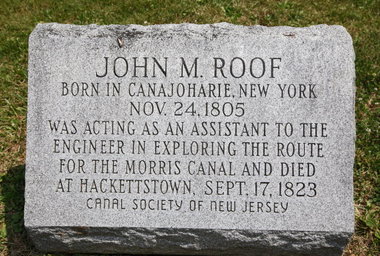
John M. Roof headstone Marching through the Colonial cemetery on Hackettstown's Main Street, Charles Prestopine frequently drops to his knees and whacks overgrowth on the recently refurbished headstones of 29 veterans of the Revolutionary War.

A key cog in the restoration of the 249-year-old cemetery and the markers of its patriots, the 75-year-old re-enactor is always tinkering.

"Your work is never done," Prestopine said.

Prestopine and a group of history enthusiasts have restored almost all of the headstones. With only a few remaining, he reflected on the group's efforts days after America celebrated its 236th birthday.
Several who served under Gen. George Washington, as well as 10 soldiers who fought in the War of 1812, are among the 1,200 souls interred in the Olde Burial Ground adjacent to the historic First Presbyterian Chapel at 291 Main St.

Prestopine, who has lived on High Street for almost 45 years, was shocked in 1998 when he witnessed the condition of the storied memorial park. He joined a committee of like-minded people who intended to resurrect history.

"The function of our committee is to restore. ... A fitting honor for those who fought in the American Revolution" Prestopine said. "That's why that little, old burial ground is important to us."
While he acknowledged that there are many cemeteries in Warren County that include Revolutionary War soldiers, he believes the Hackettstown site has one of the largest groups.

"If it isn't the most, it's close," Prestopine said. "I think we're up there in the top. ... Twenty-nine is a good number."

Bob Considine, a spokesman for the New Jersey Department of Environmental Protection, said the state is unsure which burial ground holds the most veterans of the American Revolution.

"We actually don't know if the Olde Burial Ground Cemetery is the largest Revolutionary War burial ground in the county or state," Considine wrote in an email last week. "There are probably some grounds that aren't listed through the Historic Preservation Office, and we don't track things like acreage for every location."

The cemetery and the chapel were both founded in 1763. Starting in 1999, the all-volunteer Olde Burial Ground Committee, led by Prestopine, has restored 183 headstones with private donations and state funding.
Eagle Scouts have helped rebuild the low stone walls that surround the site, and there are still several headstones that need major repairs.

Prestopine, who retired as a history teacher from Hopatcong High School in 1994, continually adds new American flags to the headstones. He said there is a sad irony to all of the volunteers' work.

"Most of the people in Hackettstown don't even know that the burial ground is there," he said. "The people who live here go by and aren't consciously aware of the historic treasures that are here."

Hackettstown Mayor Maria DiGiovanni implores residents to take a stroll through the cemetery.

"If people haven't actually gone there to see it, especially if you live in Hackettstown, take a half-hour out of your day and just go and look at those graves," she said. "... Feel the history in the burial ground."

Other notable people buried there include John M. Roof, an associate engineer of the Morris Canal who died in town of the yellow fever, and the family of Capt. William Helms, a member of the 2nd New Jersey Regiment who hailed from Hackettstown.

Gen. Washington traveled north and south on County Route 517, a Colonial highway, from the highlands of New York to Trenton, and was a frequent visitor to Hackettstown. He visited often with Lt. Robert Wilson, who was influential in supplying the Continental Army at Morristown's Jockey Hollow camp with supplies during the hard winters of 1779 and 1780.

In 2006, the Board of Trustees of The Association for Gravestone Studies presented The Oakley Certificate of Merit, an international award for preservation of gravestones and expanded public awareness, to the Burial Ground Committee for distinguished achievement in promoting the mission of the association.
On Thursday, Prestopine parked his truck, walked among the small stones and new markers and then sat nearby and looked admirably at what he saw.

"I say to the 29 Revolutionary War soldiers, 'Rest in peace,'" he said, "Job well done."


Wednesday, July 25, 2012

Reenactment this weekend at Fort Laurens

This took place on July 14, 2012, but it will doubtless be repeated next year.

From Times Reporter:  Reenactment this weekend at Fort Laurens
Fort Laurens State Memorial will host the Brigade of the American Revolution as it presents “Revolution on the Tuscarawas” on Saturday and Sunday.

This two-day encampment and reenactment will feature two mock battles each day, as well as artillery demonstrations, rifle and musket demonstrations and an 18th-century flea market on Saturday and Sunday.
Re-enactors from the 8th Pennsylvania Regiment from the American side, as well as British soldiers from the King’s 8th Regiment of Foote, will be in camp and be able to demonstrate their weaponry and give visitors a taste of colonial life.

A special ceremony will take place on Saturday and Sunday at the Tomb of the Unknown Patriot of the American Revolution on the Fort Laurens grounds. There also will be guided tours given by 18th-century civilians and soldiers. Children’s colonial games will take place throughout the day.
Activities and demonstrations will be held from 10 a.m. to 5 p.m. Saturday and from 10 a.m. to 4:30 p.m. Sunday.

Admission is $7 for adults, $3 for children 14 and younger and $1 for Friends of Fort Laurens and Ohio Historical Society members with membership information.

For more information, contact Fort Laurens at 330-874-2059 or toll-free at 800-283- 8914, email fortlaurens@wilkshire.net or visit www.fortlaurens.org or www.facebook.com/fortlaurens.


American Legion Calls for Rejection of Arms Trade Treaty

From MarketWatch:  American Legion Calls for Rejection of Arms Trade Treaty

INDIANAPOLIS, Jul 10, 2012 (BUSINESS WIRE) -- Calling a proposed United Nations Arms Trade Treaty a "potential threat to our Constitutional rights," the head of the nation's largest organization of wartime veterans said the White House and the U.S. Senate should reject any proposal that usurps the sovereignty of the American people. 

"Since the American Revolution, America's veterans have defended the U.S. Constitution," said American Legion National Commander Fang A. Wong. "Many died. Many bled. The American Legion has always opposed usurpation of U.S. sovereignty by an international body. We opposed the International Criminal Court on the grounds that it left U.S. service members vulnerable to charges of alleged war crimes. We opposed the Law of the Sea Treaty (LOST) because it created a precedent for future share-the-wealth schemes. We opposed U.S. troops being placed under the command of U.N. forces. And any Arms Trade Treaty that not only threatens the Second Amendment rights that are enshrined in our Constitution, but also represents the growing movement to place an international entity above our governing and founding document will be opposed. While we understand the effort to combat the international trade in arms that make possible human rights violations and genocide, the drafters should be cognizant that the United States views its Constitution, including the Second Amendment, as preeminent." 

The American Legion has been a staunch defender of the U.S. Constitution since the organization was founded in 1919. It has repeatedly passed national resolutions reaffirming support for the Second Amendment and other constitutional rights. At its 1996 national convention in Salt Lake City, American Legion delegates unanimously passed a resolution reaffirming that "the efforts of government should be directed to the enforcement of existing laws rather than banning the possession of firearms by the millions of our citizens who desire them for traditionally legitimate purposes..." 

The American Legion was founded on the four pillars of a strong national security, veterans affairs, Americanism, and youth programs. Legionnaires work for the betterment of their communities through more than 14,000 posts across the nation.
SOURCE: The American Legion


Monday, July 23, 2012

America's founding ideal was more than a 'notion'

From AsburyParkPress:  America's founding ideal was more than a 'notion'

It is always gratifying to read an editorial (July 4) in the Press celebrating the ideals fashioned into the Declaration of Independence. Thomas Jefferson assembled all the rationality of the Enlightenment in his statement that “We hold these truths to be self-evident, that all men are created equal.”

My critique of your editorial is with your preceding paragraph, however, wherein you say: “America is a nation founded on a notion, birthed by the ideas of liberty and equality.” Is your definition of the word “notion” that it was only a glimpse of an idea that propelled our founders? A general idea, a desired inclination, a whim perhaps? Imaginary, not real or actual? What could you have possibly meant by a “notion” of an idea?


Those who signed that state paper pledged their lives, their fortunes, and their sacred honor, knowing full well that, if caught, they would definitely be hanged as traitors; but they also hoped to walk away from the British Empire without much ado. The problems in Massachusetts were not considered germane to the greater issue of a separation from the mother country.


The American Revolution can be seen as more of a rebellion, certainly; and, in some areas such as New York and New Jersey, a civil war. But rebellion in the violent terms expressed during the American Revolution, and the concept of revolution itself, is not part of the “warp and woof of America.”


The United States has always been propounded on a higher idea of freedom than exists anywhere else in the world. It is no “notion” of liberty or equality that we seek violence for violence’s sake.


It is the real freedom to speak, to assemble, to worship, and, yes, to dissent from government’s (sometimes) troublesome authority; and to vote out those who trouble us most, thereby constantly changing our government, a quiet revolution of sorts, according to our lights.


Stephen T. Nelson
Berkeley


Saturday, July 21, 2012

Column: Revolutionary Revolutionary museum

From Architecture Here and There Blog:  Column: Revolutionary Revolutionary museum

revonightview.jpg
RAMSA
Museum of the American Revolution at night
 
A museum of the Revolutionary War had better be revolutionary, eh?

So it appears, to judge by critics of Robert A.M. Stern's design, unveiled last month, for the proposed Museum of the American Revolution, in Philadelphia. Except that the only definition of "revolutionary" acceptable to most architecture critics is the conventional definition: modernist. That is, it must "look like the inside of a refrigerator," to quote one commenter, "honcho," exasperated by the entirely predictable critical fusillade against Stern's admirable building.

"Looking For Revolutionary American Architecture? You Won't Find It at the New Museum of the American Revolution," cries critic Nathaniel Popkin at hiddencityphila.org. "Imitation," he asserts, "is the self-imposed prison of an architect without imagination."

(Huh? History of architecture circa 500 B.C. to A.D. 1950, call your office!)

"Robert A.M. Stern's Conservative Museum of the American Revolution Design Snuffs the Revolutionary Spirit" is the boilerplate thrust of Kelly Chan's critique at artinfo.com. "To insist on the need to graft a 'historical' building onto a historical site is to reduce the area's vast and varied history to a shallow, vague -- not to mention confused -- image of the past."

In a gentler tone, Philadelphia Inquirer critic Inga Saffron also disparages the design. "Our forefathers," she declares, "created a new nation by marrying what was good about the past with the latest ideas about organizing society. The design for the Museum of the American Revolution should aspire to no less."

In short, she, like most of her fellow architecture critics, will only be satisfied if a Martian spaceship lands near Independence Hall. Only buildings that imitate the intergalactic motif popular among starchitects in recent decades will do. Show Stern the gate, please! A conventional revolutionary style requires something on the order of Frank "O!" Gehry's whirly-swirly, or maybe the ziggy-zaggy of Zaha "Ha-Ha" -- excuse me, Dame "Ha-Ha" -- Hadid, recently knighted by Queen Elizabeth II.

What the critics resist acknowledging is that Stern's design is by far the more genuinely revolutionary. The modernist movement in architecture is a century old, and has been dominant in America for more than half a century. It is the establishment. Most people dislike it, and are glad traditional beauty is fighting back.
The methods used by the architectural establishment to suppress such a revival would make King George III blush. Totalitarian is not too strong a word for the phenomenon.

The study of architectural history and practice was literally purged from the curricula of almost all architecture schools after World War II, and remains so today. Students with classical sensibilities are browbeaten regularly by professors. Traditional building proposals are excluded from public, commercial and institutional commissions by rigged competitions and brainwashed facilities committees and corporate boards. Skilled jobs held by generations of immigrant craftsmen have been killed in the process, enabling modernists to intone blandly that capable artisans are difficult to find. Ugliness has become so pervasively integrated into culture that resistance seems futile -- so much so that the mass German pychosis under Nazi rule, as described by Daniel Jonah Goldhagen in Hitler's Willing Executioners (1996), leaps to mind.

True, there has been no Boston Massacre in architecture. None was necessary. Classical architecture went softly into that dark night. Society accepted the New Order like a "bracing slap across the face," as Tom Wolfe put it in From Bauhaus to Our House (1981).

But today, the classical revival is as revolutionary as any movement America has seen in recent decades. Bob Stern is among its leaders. His museum design, carried out with RAMSA partners Alexander P. Lamis and Kevin Smith, reflects its spirit. This is what its critics, with their narrow-minded sense of the revolutionary, refuse to acknowledge.

Indeed, Stern's design is not at all the slavish imitation of historical precedent that the critics would lead you to expect. Rather, its Georgian classicism doffs its hat to contemporary design clichés with such vigor that no sentient third grader could fail to discern its recent vintage. Not enough to prevent it from fitting into Philadelphia's founding historic district -- already marred by modernism -- but too much for its critics to admit without revealing the cynicism and insincerity of their criticism.

So don't be alarmed. For the rest of us, Philadelphia's new Museum of the American Revolution will be plenty revolutionary.