Thursday, December 27, 2012

Conference approves memorial for African American Revolutionary War heroes

From Examiner.com:  Conference approves memorial for African American Revolutionary War heroes

Blacks who fought in the Revolutionary War may eventually get their own memorial in Washington, DC. A congressional conference committee on Tuesday, December 18 agreed to a National Defense Authorization Act for FY 13 that includes a provision allowing a Memorial to Slaves and Free Black Persons Who Served in the American Revolution.
The memorial could go on unspecified federal land in the District of Columbia.
The National Mall Liberty Fund DC would get the authorization to build the monument but it would have to use non-federal funds.
According to the legislation, the monument would “honor the more than 5,000 courageous slaves and free black persons who served as soldiers and sailors or provided civilian assistance during the American Revolution.”
The provision is included in the national security bill, which you can read here: beta.congress.gov/bill/112th-congress/senate-bill/3254/text.
Congress must approve the bill and President Barack Obama must sign it before it takes effect.
For details, see the stories linked to below.


Tuesday, December 25, 2012

The Oxford Handbook of the American Revolution

From PhilipVickers.com:  The Oxford Handbook of the American Revolution

The blog of the Huntington Library has an informative post on the recently published The Oxford Handbook of the American Revolution, edited by Edward Gray and Jane Kamensky.  (You can buy a copy on Amazon for $150.00, but if the good people at Oxford Press were to send me a review copy I would be happy to do a blog series here at The Way of Improvement Leads Home).  The handbook includes thirty-three essays on the American Revolution written by leading scholars in the field, including Michael Zuckerman, Laurel Thatcher Ulrich, Ray Raphael, Ben Irvin, Mark Peterson, Allan Kulikoff, Jane Merritt, Gary Nash, Sarah Pearsall, Edward Larkin, Paul Mapp, Stephen Mihm, Terry Bouton, Susan Juster, Eric Slauter, Christopher Brown, Eliga Gould, Rosemarie Zagarri, Graham Hodges, and J.M. Opal.  The coverage extends into the early republic.

According to the Huntington blog post,  Gray and Kamensky write that scholarly works on the American Revolution have been declining over the past twenty-five years even as popular biographies of the founding fathers and the  American Revolution are on the rise.  This confirms some things I have been thinking in the past couple of weeks as I spend time on my own project on the American Revolution.

Just yesterday I was reading Joseph Tiedemann's 1988 Journal of American History article: "Revolution Foiled: Queens County, New York, 1775-1776."  It is an excellent study of the American Revolution in one local community. As I read the piece, I also thought about Sung Bok Kim's "The Limits of Politicization in the American Revolution: The Experience of Westchester County, New York, JAH 1993, Francis Fox's Sweet Land of Liberty: The Ordeal of the American Revolution in Northampton County, PA (2003), Liam Riordan's Many Identities, One Nation: The Revolution and its Legacy in the Mid-Atlantic, Marjoleine Kars's Breaking Loose Together: The Regulator Rebellion in Pre-Revolutionary North Carolina, and a host of other essays and monographs that fleshed out the experience of the Revolution on the ground.  (I am sure I am missing many others).   Are people still doing this kind of local scholarship on the American Revolution?

As part of the publication of this landmark book, Gray and Kamensky staged a conference at The Huntington on British perceptions of the Revolution.  You can listen to some of the presentations from that conference here


Wednesday, December 19, 2012

New posting schedule

Now that I've got this new full-time job, I'll be posting in this blog twice a week - on Monday's and Wednesdays.

So the next post for this blog will be on Monday.

Thanks for your patience.

Monday, December 17, 2012

Posts resume this Wednesday

I'm a freelance writer and I am way behind on a job I have to do, so I won't be posting here until Wednesday..

Thanks for your patience!

Friday, December 14, 2012

14 December: Events of the Day

1799
 George Washington born on February 22, 1732 in t he new style of calendar (which went into effect in 1752) or February 11, 1731 in the old style. He died on December 14, 1799.
Contemporary records, which used the Julian calendar and the Annunciation Style of enumerating years, recorded his birth as February 11, 1731. The provisions of the British Calendar (New Style) Act 1750, implemented in 1752, altered the official British dating method to the Gregorian calendar with the start of the year on January 1 (it had been March 25). These changes resulted in dates being moved forward 11 days, and for those between January 1 and March 25, an advance of one year.

Monday, December 10, 2012

American History: Peace Treaty Ends American Revolution


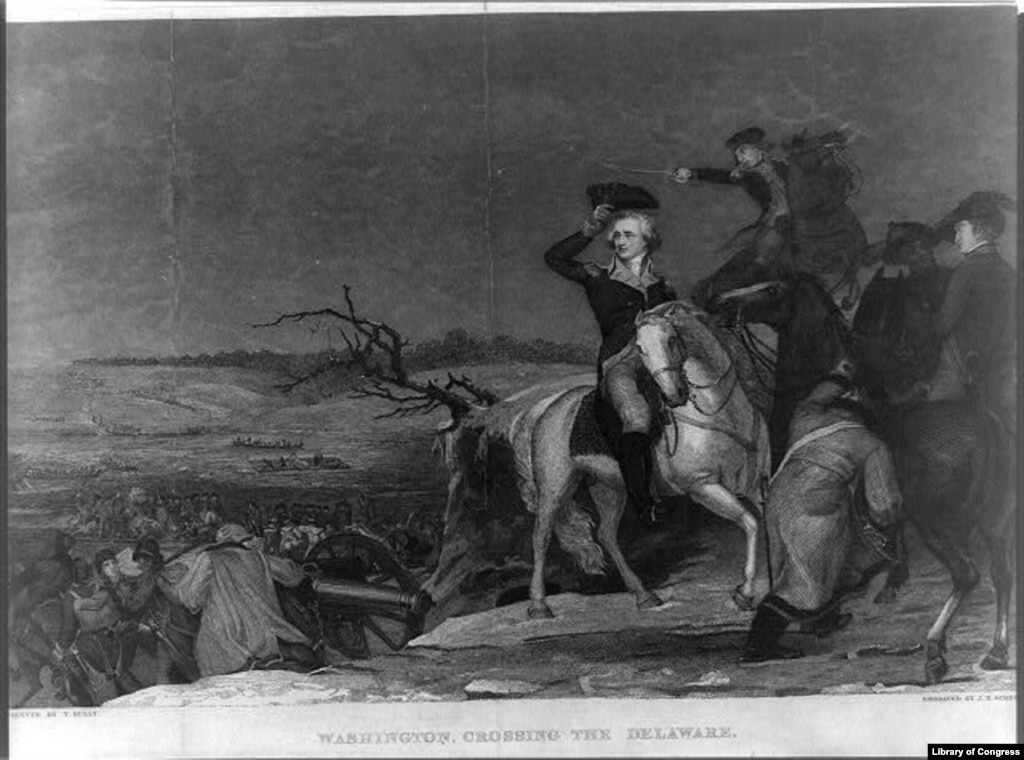
Print: "Washington, Crossing the Delaware"


Voice of America: American History: Peace Treaty Ends American Revolution

From VOA Learning English, this is THE MAKING OF A NATION – American history in Special English. I'm Steve Ember.

This week in our series, we complete the story of the American Revolution.

The time is December seventeen seventy-six. British General William Howe has decided to stop fighting during the cold winter months. The general is in New York. He has already established control of a few areas near the city, including Trenton and Princeton in New Jersey.

General George Washington and the Continental Army are on the other side of the Delaware River. The Americans are cold and hungry.  They have few weapons. Washington knows that if Howe attacks, the British will be able to go all the way to Philadelphia.

"And he's looking at his army which is melting away…”

Historian Gordon Wood says that moment was the low point of the war for George Washington.

"…and he decides to make one great effort on Christmas night and crosses the Delaware in dead of winter — cold, ice — and he crosses it and attacks Trenton, where you have about one thousand Hessians who are kind of overwhelmed and defeated. It's a small tactical victory but a great psychological effect, because it's the first time that Washington's ever actually done something positive, and it really does, I think, change the psychology of the war."

Another result of the victory at Trenton was that more men decided to join the army. It now had ten thousand soldiers. This new Continental Army, however, lost battles during the summer to General Howe's forces near the Chesapeake Bay. And in August seventeen seventy-seven, General Howe captured Philadelphia.

Following these losses, Washington led the army to the nearby area of Pennsylvania called Valley Forge.

"Valley Forge was the camp where George Washington and his army spent a really miserable, miserable winter.”

Alice Kamps is a curator at the National Archives in Washington, where some of the country's most important documents are kept. One of those documents is a letter that George Washington wrote from Valley Forge.

KAMPS: "The men had nothing to wear, they had no blankets, they had very little to eat. Illnesses were rampant. It was a very, very miserable experience for them."

But in the middle of that winter, Washington finds out that France has decided to sign a treaty with the colonists.

"This is fantastic news. This is the kind of news that would make anyone just run about screaming with joy and doing handstands. But Washington is so reserved, and he says that he's received this news with, quote, the most sensible pleasure, unquote."

He also says he is going to wait for the government to approve the treaty before he tells the army.

"The fact that he is not going to announce this news immediately to his army speaks to the fact that he was always, always concerned with doing the right thing and with protocol."

By the spring of seventeen seventy-eight, General Washington and his army were ready to fight again.

General Howe was still in Philadelphia. His behavior as a military leader was sometimes difficult to understand. At times, he was a good commander and a brave soldier. At other times, he stayed in the safety of cities, instead of leading his men in battle.

The next series of important battles in the American Revolution was led by another British general, John Burgoyne. His plan was to capture the Hudson River Valley in New York state and separate New England from the other colonies. Doing this, the British believed, would make it easier to capture the other colonies.

The plan did not succeed. American General Benedict Arnold defeated the British troops in New York. General Burgoyne had expected help from General Howe, but that help never came. Burgoyne was forced to surrender at the town of Saratoga.

The American victory at Saratoga was extremely important. It ended the British plan to separate New England from the other colonies. It also showed European nations that the Americans might be able to win their revolution. This was something that France, especially, had wanted ever since being defeated earlier by the British in the French and Indian War.

The French government had been supplying the Americans secretly through the work of America's minister to France, Benjamin Franklin.  Franklin was popular with the French people and with French government officials. He helped gain French sympathy for the American cause.

After the American victory at Saratoga, the French decided to enter the war on the American side. The two nations signed military and political treaties. Historian Gordon Wood says this alliance created bigger problems for the British.

"Because, once the French were involved, it turns the thing from counterinsurgency for the British. They're now fighting a world war."

The British immediately sent a message to America's Continental Congress. They offered to go back to a time of better relations. The Americans rejected the British offer. The war would be fought to the end.

In seventeen seventy-nine, Spain entered the war against the British.  And the next year, the British were also fighting the Dutch to stop their trade with America.

The French now sent gunpowder, soldiers, officers and ships to the Americans. However, neither the Americans nor the British made much progress in the war for the next two years.

By seventeen eighty, the British had moved their military forces to the American South. They quickly gained control of South Carolina and Georgia. But the Americans prevented them from taking control of North Carolina. After that, the British commander moved his troops to Yorktown, Virginia.

The commander's name was Lord Charles Cornwallis. Both he and George Washington had about eight thousand troops when they met near Yorktown.  Cornwallis was expecting more troops to arrive on British ships.

What he did not know was that French ships were on their way to Yorktown, too. Their commander was Admiral Francois Comte de Grasse. De Grasse met some of the British ships that Cornwallis was expecting, and defeated them. The French ships then moved into the Chesapeake Bay, near Yorktown.

The Americans and the French began attacking the British with cannons. Then they fought the British soldiers hand-to-hand.  Cornwallis knew he had no chance to win without more troops. He surrendered to George Washington on October seventeenth, seventeen eighty-one.

The war was over. American and French forces had captured or killed half of the British troops in America. The surviving troops left Yorktown playing a popular British song called "The World Turned Upside Down."

(MUSIC: “The World Turned Upside Down”)

How were the Americans able to defeat the most powerful nation in the world? Historians give several reasons:

The Americans were fighting at home, while the British had to bring troops and supplies from across the ocean. British officers made mistakes, especially General William Howe. His slowness to take action at the start of the war made it possible for the Americans to survive two difficult winters.

Historian Gordon Wood at Brown University in Rhode Island says the British also thought more colonists would support them.

"When Burgoyne comes down the Hudson Valley he starts out with an army of ten thousand or so, and he has to hack his way through the woods, and he keeps losing troops to small militia. He counted on more loyalist support than there was. And I think the British miscalculated terribly on that point."

Another reason the Americans won was the help they received from the French. Also, the British public had stopped supporting the long and costly war.

Finally, America might not have won without the leadership of George Washington. He never gave up hope.

The peace treaty ending the American Revolution was signed in Paris in seventeen eighty-three. The independence of the United States was recognized. Western and northern borders were set.

The thirteen colonies were free. Now, they had to become one nation.

Sunday, December 9, 2012

Re-enactors celebrate that other historic crossing

From PhillyBurbs.com:  Re-enactors celebrate that other historic crossing 

Monroe Crossing Less celebrated spirits of the American Revolution marched through New Hope on Saturday and were hard to ignore, especially with their cannon.
Dozens of historical re-enactors — some black, others women, and a handful with physical disabilities — celebrated the other historic crossing of the Delaware River on Christmas Day 1776.
New Hope hosted the 27th annual Lt. James Monroe Crossing the Delaware Parade. Monroe led a contingent across the Delaware six hours ahead of the main force led by George Washington in the Battle of Trenton.
Cannon fire rang out from a small park on East Ferry Street in the borough.
Among the re-enactors, Jim Anderson of Springfield, N.J., said he represented the Corps of Invalids, which also fought for American independence.
“People often ask me: Did anyone really look like you during the Revolution?” said Anderson, who was born with just one leg. “There was a Corps of Invalid. These were men who could no longer fight but did important functions for the Continental Army.
“The Corps of the Invalid would be clerks, hospital guards, drivers of wagons,” Anderson continued. “They did do some fighting, but not all that much, depending on the severity of disability. It’s really not in the text books, and unless you’re disabled, as in my case, you have an interest to learn about those that were taking part.”
Revolutionary War records of the Pennsylvania State Archives contain references to a “Corps of Invalids” in the Pennsylvania Line. Such men were found capable of light garrison duty and transferred to a special continental regiment, records suggest.
Re-enactor James Howard of Lambertville said he was not there portraying any one person, though he could have represented any one of the many free blacks to cross the Delaware in 1776, according to historical sources.
The iconic painting of Washington’s Crossing shows at least one black soldier helping to steer the boat.
However, that painting also shows Lt. Monroe in that same boat as Washington for the Christmas crossing. Monroe’s presence in that boat, along with other discrepancies, is most often chalked up to artistic interpretation.
The Pennsylvania Historical and Museum Commission offers a comprehensive look at the many discrepancies between historical sources and the painting composed in 1851. Artist Emmanuel Leutze, who was German, used the Rhine River in Germany as his model for an icy waterway.
The painting clearly shows troops crossing the river in daylight when the attack is largely believed to have occurred late at night and in driving snow.
Monroe and Washington are clearly shown standing together in the boat, while most others remain seated. However, the type of Durham boats used during the crossing contained no seats, according to the museum commission.
Monroe is also shown holding a version of the American flag created by Betsy Ross. And, historians doubt such a flag would have been available to Continental troops at that time in history.
Monroe was indeed present for the Battle of Trenton and was severely injured during the fighting, according to the Library of Congress.
He later went on to become the fifth U.S. president in 1816 and was re-elected in 1820. Monroe is also one of three Founding Fathers said to have died on July 4. Monroe passed away on July 4, 1858. Fellow American Presidents John Adams and Thomas Jefferson both died July 4, 1826.
Re-enactor Mitch Davis said he’s amazed that so few Americans know these stories. Most never progress beyond what they learn in high school textbooks, he said.
“There are many foreigners who come here and they know more about the Revolution than Americans do,” said Davis, a machinist and fencing instructor from Lambertville.
Howard said he couldn’t live near the site of Washington’s Crossing and not study it.
“This area is so full of history, and, if you love history, then you’re just sort of get drawn into it,” he said. “You read the correspondence and the personal letters of the different people, soldiers to their families, and you get a whole different sense of how important it all was.
“It’s about being more than a visitor and just a sightseer,” continued Howard. “This is a national shrine.”